

Material & design fieldnotes
Stone fissures, cracks and repairs: build a useful inspection record
A photograph alone cannot reliably establish whether a visible line is an accepted natural feature, a repair or damage affecting the piece. The practical next step is a documented comparison: material identity, location, condition, support and the agreed approval record.
01 / Detail to resolve
Record what is visible without diagnosing it.
Photograph the whole piece, then the line or affected area from several angles with a useful scale. Mark its position on a plan or elevation and record the date. Describe observable features such as an open gap, uneven surface, movement or an edge chip instead of relying only on a label.
Compare with the approved slab and arrival photographs. A line that was clearly recorded before fabrication raises a different discussion from a new opening after delivery. Neither history alone proves that the final assembly is suitable; it provides context for the responsible assessor.
02 / Detail to resolve
Separate appearance from the condition of the assembly.
A natural-looking vein may be visually dramatic without being an open break. Conversely, a small or disguised repair can require attention because of its position or the way the piece is supported. The line's appearance is only one part of the assessment.
Locate nearby cut-outs, narrow sections, edges, supports and fixings. If a piece has moved or feels unstable, avoid further loading or handling and ask the responsible supplier or installer to assess it. Do not use a remote photograph as a basis for an improvised structural repair.
03 / Detail to resolve
Ask what a proposed repair will achieve.
A cosmetic colour match, a fill and a repair intended to restore continuity have different purposes. Request a description of the proposed work, the expected appearance, limitations and any changes to care. Ask whether the repair affects the agreed finish or creates a visible difference under side lighting.
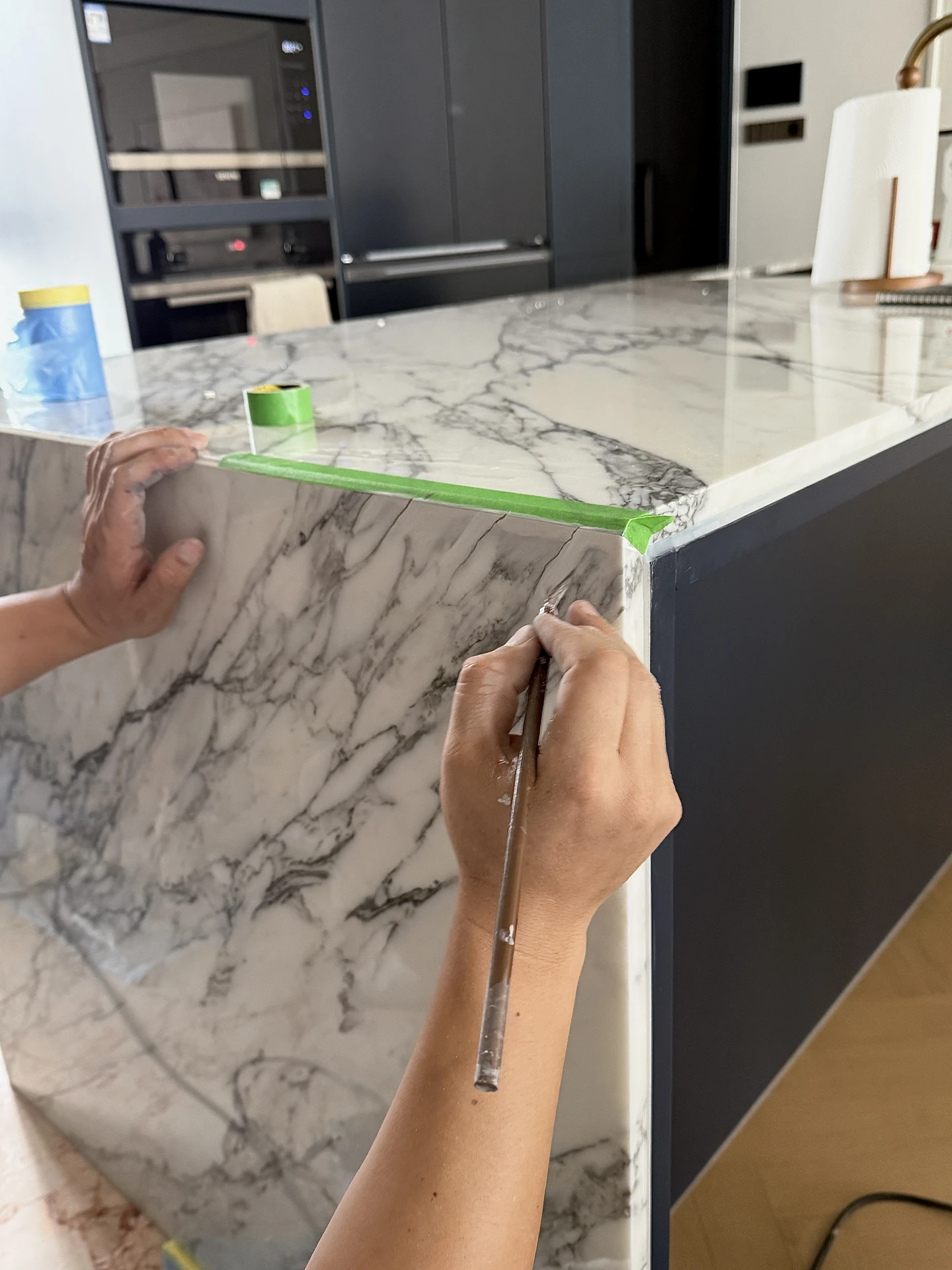
A collected repair account shows how much attention can go into disguising a repaired area. Its before-and-after presentation does not provide a transferable performance guarantee. Judge the proposed work against the actual piece, not a percentage of visual restoration claimed in a social post.
04 / Detail to resolve
Keep delivery and reporting procedures clear.
For a concern on arrival, retain crate and condition photographs and follow the agreed carrier and order reporting process. Keep the packaging until the relevant checks are complete where practical, and avoid altering the area before the responsible parties have seen the record.
After assessment, retain the conclusion and any repair information with the project file. A clear record is useful if the appearance changes later. Do not assume that every line must be rejected or that every line can be dismissed as natural stone.
Compare the choices
What each description tells you.
Visible colour or vein
An appearance observation.
Compare against the selected slab.
Open or uneven line
A condition that needs assessment.
Record the location, scale and any movement.
Cosmetic repair
An appearance-focused intervention.
Ask about finish match and maintenance.
Assembly concern
A question involving geometry and support.
Have the responsible professional assess the piece.
Your project checklist
Keep the decisions together.
- Whole-piece and detailed dated photographs.
- Location marked on the drawing.
- Slab approval and arrival records.
- Observable gap, unevenness or movement.
- Nearby openings, edges and supports.
- Written assessment and any repair scope.
Questions, answered
Before you decide.
Can a line be diagnosed from a single image?
A single image usually cannot establish the condition of the material and assembly. Provide context, different views and the approval record, and obtain an appropriate assessment for the actual piece.
Does a natural fissure label mean no action is needed?
The label does not settle the question. Position, condition, treatment, support and intended use still matter. Ask for an assessment that addresses the finished assembly.
Does a cosmetic repair prove restored strength?
No. Appearance and performance are different outcomes. Ask what the repair is intended to achieve and what evidence or limitations accompany it.
What should I do if damage is noticed at delivery?
Document the package and piece, retain relevant evidence and follow the agreed reporting procedure. Do not begin a repair before the responsible supplier or carrier has had an opportunity to review the record.
Continue the project.
Sources & image context.
The image records an appearance intervention, not proof of restored structural performance. Collected references are third-party examples, not AxoStone customer or production records. The guidance is an original editorial synthesis; a reference post does not validate technical performance claims.
View the source notes
General stone-care and treatment context: Natural Stone Institute — care & cleaning; sealing stone; consumer countertop guide. These general references do not replace the current instructions for the selected stone, treatment, fitting or assembly.